

.svg)

Turning Aquaculture Waste Into Economic Opportunity.
The Problem
Turning Aquaculture Waste Into Economic Opportunity: A Replicable Model for the Mekong Delta A Comprehensive Playbook for Circular Economy Solutions in Aquaculture Regions
In Vietnam's Mekong Delta, intensive shrimp and fish farming drives economic prosperity for millions of people. But this success comes with a hidden cost: thousands of tons of plastic pond liners discarded annually as operations expand and materials need replacement every few years.
For years, these materials ended up burned in fields, buried in makeshift dumps, or polluting the intricate waterway networks that define the Delta. Farmers faced disposal costs. Communities dealt with pollution. And valuable material resources were simply being lost. We saw an opportunity to close the loop.
The Challenge We Set Out to Solve The aquaculture industry in the Mekong Delta relies heavily on polyethylene pond liners—essential for intensive farming operations but creating a substantial waste management challenge when they reach end-of-life. With farming operations spread across remote rural areas, traditional centralized recycling systems simply didn't work. The logistics were too complex, the costs too high, and the infrastructure too distant.
But what if this waste stream could become a valuable resource instead?
The Solution
Working alongside Dow Chemical, we spent years developing and refining a practical solution to this challenge. Today, we're sharing our learnings in the Aquaculture Plastic Waste Recovery Playbook—a comprehensive guide for implementing sustainable waste collection and processing systems that achieve both environmental impact and economic viability.
Why We Were Positioned to Lead This Work Since 2016, Evergreen Labs has been building decentralized circular economy systems across Southeast Asia. We don't design solutions from boardrooms—we build them in communities, testing what actually works in real-world conditions with real economic constraints.
We knew from experience that sustainable solutions require: -Systems designed for local conditions (not imported models) -Economic viability for all stakeholders (not subsidy-dependent programs) -Community ownership (not external dependency) -Proven replicability (not one-off pilot projects)
When Dow Chemical sought a partner to develop aquaculture waste recovery systems in the Mekong Delta, they needed an organization that understood both material science and community-based implementation. That's where our partnership began.
Building a System That Works for Everyone Our approach wasn't just about collecting plastic—it was about creating a complete circular economy system with value at every stage:
For Farmers: We established transparent pricing systems that turn waste disposal from a cost into a potential revenue stream. Instead of paying to get rid of pond liners, farmers could sell them. We provided collection equipment and training support, making participation simple and economically beneficial.
For Communities: We created local employment through collection and processing operations, investing in skills development and building environmental awareness. Rather than importing labor or expertise, we built local capacity—ensuring the system could operate sustainably long-term.
For the Environment: We're diverting plastic waste from landfills and waterways while reducing carbon emissions by up to 70% compared to virgin material production. The environmental case was clear, but only mattered if the economic case worked too.
For the Market: We're producing quality recycled materials that compete with virgin plastics across multiple product streams—from new pond liners to construction materials and consumer products. Competitiveness on price and quality was non-negotiable.
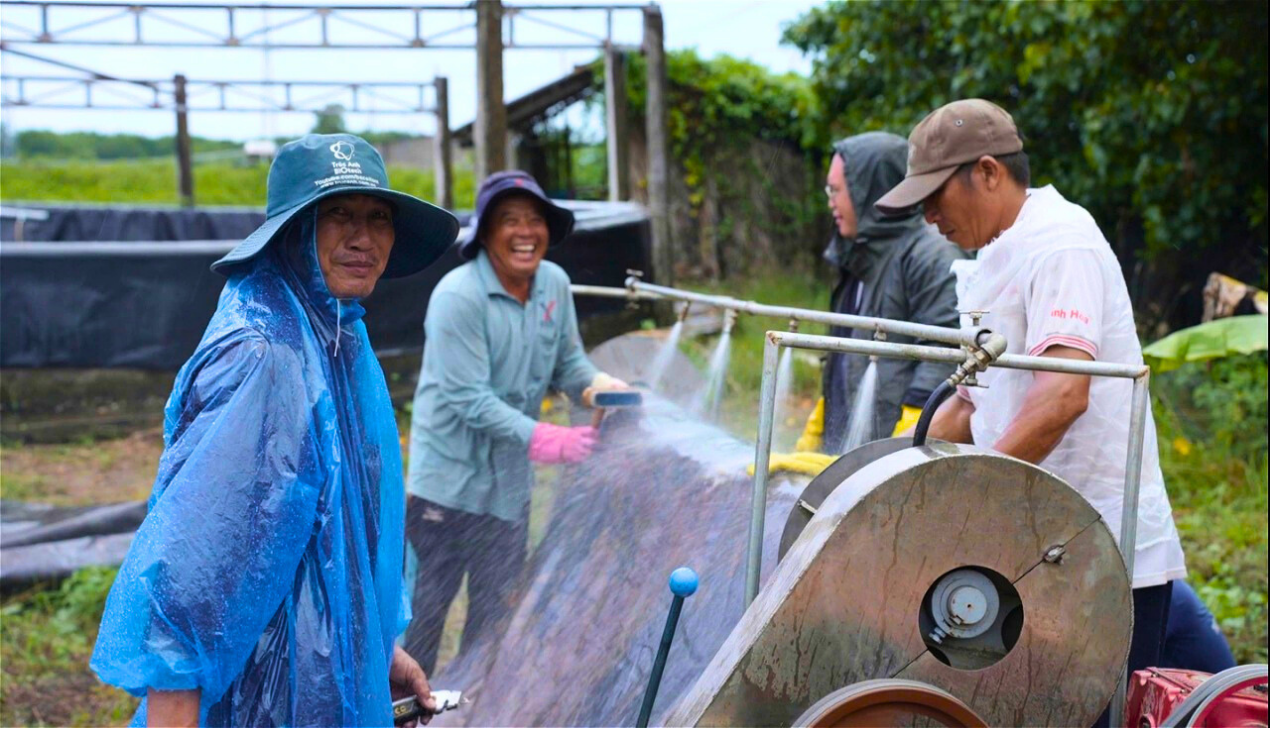
Innovation on the Ground One of our key innovations was developing custom collection equipment designed specifically for rural aquaculture conditions. This wasn't about importing expensive, complex technology—it was about designing practical solutions that work in real-world Mekong Delta conditions.
The Equipment We Built:
-Portable machines that can be transported via motorbike or trike to remote farm locations
-On-site processing capacity of 130 m²/hour, handling pond liners where they're discarded
-Combined operations that wash and collect in one process
-Locally sourceable materials for construction and maintenance
-Community-trainable operation—no specialized technicians required
This equipment philosophy reflects our broader approach: accessible sustainability through decentralized innovation. Solutions should be available to those who need them most, built from materials they can access, and operated by people in their communities.
The Multi-Stream Approach to Economic Sustainability Economic viability required diversifying our product outputs. We developed three processing streams, each serving different market segments:
Stream 1: High-Value Recycled Pellets Meeting virgin material specifications for premium applications—proving recycled can match virgin quality
Stream 2: Standard Products Tarpaulins, shade nets, and agricultural materials for cost-competitive markets—maximizing volume utilization
Stream 3: ReForm Plastic Boards Furniture, construction materials, and signage—creating entirely new product categories from waste streams
This diversification creates market resilience. When one stream faces demand fluctuations, others maintain revenue stability—critical for long-term sustainability.
What We Learned: The Reality of Implementation We want to be transparent about the challenges we faced. Building this system took longer than initially planned, required more adaptation than expected, and taught us lessons we couldn't have anticipated from planning documents.
Key Lessons:
1. Early government engagement is essential -Present clear environmental and economic benefits from day one -Establish regular communication channels with relevant authorities -Plan for extended approval timelines (12-18 months in our case) -Document everything for regulatory compliance
2. Partnership flexibility matters -Maintain multiple options for critical functions rather than single dependencies -Build internal capabilities to reduce external vulnerabilities -Create performance-based agreements with clear, measurable metrics -Expect partnerships to evolve—plan for adaptation
3. Quality control is non-negotiable -Effective recycling requires rigorous contamination control from initial collection through final processing -Implement consistent testing and documentation at every stage -Ensure material traceability for customer confidence and regulatory compliance -Invest in quality assurance systems early—retrofitting is expensive
4. Timeline flexibility is crucial -Implement milestone-based plans with clear decision points for strategy adjustments -Maintain alternative pathways when things don't go as expected -Build buffer time for regulatory processes, equipment testing, and market development -Celebrate progress milestones to maintain team and stakeholder momentum
Sharing What We've Learned The Aquaculture Plastic Waste Recovery Playbook we've developed documents everything from pre-implementation assessment and stakeholder mapping to technical infrastructure planning, collection system design, and financial sustainability frameworks.
What's Inside: -Detailed guidance on regulatory navigation across different contexts -Risk management frameworks based on actual challenges faced -Scaling strategies proven through implementation -Equipment specifications and sourcing guidance -Quality control protocols and testing procedures -Financial modeling templates for replication -Stakeholder engagement approaches that build trust
But more than a manual, it represents our commitment to knowledge sharing as impact multiplication. We believe circular economy solutions should be available to those who need them most, not locked away as proprietary knowledge.
A Model Designed for Replication While this project focused on the Mekong Delta, the model is designed for replication across aquaculture regions worldwide. The framework can be adapted to different regulatory environments, market conditions, and local circumstances—anywhere there are: intensive shrimp or fish farming operations; significant pond liner replacement cycles; access to recycling markets; government interest in circular economy solutions; communities seeking economic opportunities.
The Impact
We've now achieved: -70%+ material recovery rates (exceeding initial targets) -Hundreds of tons processed annually (and scaling) -Local employment creation (collection, processing, operations) -Economic competitiveness (recycled materials competing with virgin alternatives on price) -Carbon emissions reduction (up to 70% compared to virgin material production)
What This Work Represents This project exemplifies Evergreen Labs' approach to circular economy: Proof through building: We don't just recommend solutions—we build them and prove they work. Community-centered design: Local ownership and economic benefit are core requirements. Knowledge as public good: Sharing learnings multiplies impact beyond single projects. Partnership for scale: Collaborating with corporations like Dow brings resources and expertise. Honest assessment: We document what didn't work as thoroughly as what did.
Looking Ahead: Scaling Impact This is just the beginning. As we scale operations and refine our processes, we're focused on:
Near-term (1-2 years): -Reaching regional hub capacity of 3,000+ tons per year -Supporting development of additional sites across Southeast Asia -Refining equipment designs based on operational learnings -Expanding product stream diversity for market resilience
Long-term vision: -Franchise and licensing models to enable local operators to implement this system in their communities -Comprehensive training programs and ongoing technical consultation for replicators -Regional network development connecting sites for knowledge sharing and market coordination -Policy influence to create enabling environments for decentralized circular economy systems
Join the Movement Circular economy solutions work when they create value for everyone in the system. By transforming waste into valuable products, creating economic opportunities, and reducing environmental impact, we can build systems that are both sustainable and scalable.
Access the full Aquaculture Plastic Waste Recovery Playbook to see detailed technical specifications, financial models, and implementation guidance.
Circular Economy Insights, Straight from the Field
Get research, case studies, and stories from building circular economy systems across Southeast Asia and beyond— from the people doing the work.

Evergreen Labs builds the circular economy in Southeast Asia and beyond.


Quick Links
About UsVenture & ProgramsFor Investors & FundersKnowledgeSystem & ServicesPartnershipsCareersContact UsContact
68 Circular Road #02-01 Singapore 049422
Vietnam Country Office:
Floor 2, Hoa Phan Building, 75 Pham Tuan Tai, Ngu Hanh Son Ward, Da Nang City
Philippines Country Office:
6th Floor, One Ayala Avenue Tower 2, Ayala Avenue, Ayala Center, San Lorenzo, Makati City NCR, Philippines, 1223
Copyright © 2026 Evergreen Labs. All rights reserved.
.svg)