

.svg)

5 municipalities transformed island-wide
The Problem
How Guimaras Island Proved Small Places Can Lead Big Change
When Evergreen Labs signed a Memorandum of Understanding to transform waste management across the entire island of Guimaras in 2024, skeptics wondered if an island of just five municipalities could really pioneer a new model for circular economy. Small islands face unique challenges: limited resources, geographic isolation, complex inter-municipal coordination, and economic constraints that make large infrastructure investments difficult. But Guimaras had something many larger places lack: the willingness to dream big and the unity to act collectively. By year's end, this small island in Western Visayas had become proof that the most innovative solutions often come from the places willing to reimagine what's possible.
The Challenge Before 2024, Guimaras faced waste management challenges common across the Philippines but amplified by geography. As an island province, waste disposal meant expensive off-island shipping or inadequate local solutions. Plastic waste from fishing boats, households, and businesses either accumulated in community dumps or found its way into the marine environment surrounding the island. Five municipalities—San Lorenzo, Sibunag, Nueva Valencia, Jordan, and Buenavista—each handled waste independently with limited resources and infrastructure. Collection systems were inconsistent. Processing capacity was minimal. Most communities had no established waste recovery programs. The conventional solution would have been building centralized facilities or continuing expensive waste export. But Guimaras chose a different path: what if island constraints could become island advantages?
Why Guimaras Was Positioned to Lead This Transformation Island geography that seemed like limitation actually created unique opportunity. Unlike mainland communities struggling with complex regional waste transport logistics, Guimaras could create contained, closed-loop systems where materials stayed local and benefits remained in the community. The island's five municipalities were small enough to coordinate effectively while large enough to generate meaningful waste streams.
The Solution
Building Island-Wide Integrated Systems The approach was revolutionary: instead of shipping waste off-island for processing elsewhere, build infrastructure to transform plastic waste into valuable resources locally, creating closed-loop systems where materials become community assets.
Integrated Waste Management Facility: The new facility in Sapal serves all five municipalities, processing mixed plastic waste into durable eco-boards and plastic lumber suitable for community infrastructure projects—schools, community centers, homes, and public facilities.
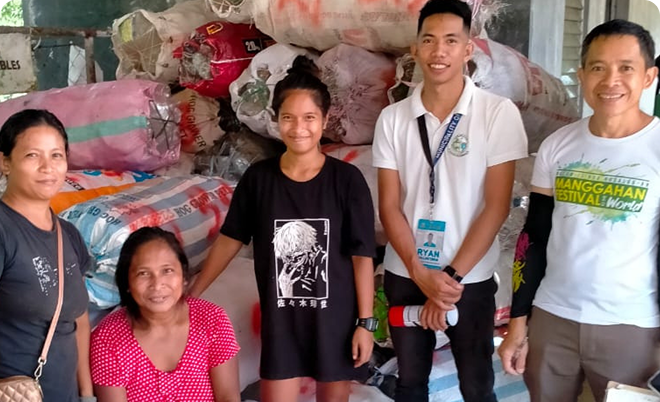
Island-Wide Collection Network: Coordinated collection systems across municipalities ensure materials from fishing boats, households, and businesses flow to processing facilities. "The incentive from Evergreen Labs kickstarted the participation and enhanced plastic recovery efforts, especially in communities where there was little to no established collection system," explains Ma. Leah Joy Gabayeron from the Guimaras Environment and Natural Resources Office.
Closed-Loop Resource Flows: Plastic waste collected on Guimaras stays on Guimaras, becoming building materials for island development. Materials unsuitable for local processing connect to partner networks like Justine's Recycling, ensuring nothing is wasted while maintaining local value creation.
Municipal Coordination: Five municipalities united under shared circular vision, demonstrating that inter-governmental cooperation can create solutions impossible for individual communities acting alone.
The Impact
What We Discovered The island-wide approach created value that exceeded the sum of individual municipal programs:
Community Empowerment: "The real breakthrough wasn't just the incentives—it was watching communities realize they had the power to solve their own problems while creating economic opportunity," reflects the implementation team.
Geographic Advantages: Island constraints became island advantages. While mainland communities struggle with complex waste transport logistics, Guimaras created contained systems where resources stay local and benefits remain in communities.
Municipal Collaboration: Five municipalities working together achieved infrastructure scale impossible individually while maintaining local control and community ownership of the system.
Economic Self-Reliance: Instead of paying for waste export, communities now generate building materials for their own development projects, creating economic value from environmental challenges.
Beyond Individual Island Success What makes Guimaras's transformation particularly significant is how it creates a replicable model for other island communities across the Philippines and beyond. As the island-wide system takes hold, Guimaras is becoming a living laboratory studied by other island communities seeking sustainable waste management solutions.
What This Represents Guimaras's transformation demonstrates that small places can lead big change when they have vision, unity, and appropriate support systems. Island communities were ready for circular systems—they just needed infrastructure designed for their specific contexts and constraints.
Circular Economy Insights, Straight from the Field
Get research, case studies, and stories from building circular economy systems across Southeast Asia and beyond— from the people doing the work.

Evergreen Labs builds the circular economy in Southeast Asia and beyond.


Quick Links
About UsVenture & ProgramsFor Investors & FundersKnowledgeSystem & ServicesPartnershipsCareersContact UsContact
68 Circular Road #02-01 Singapore 049422
Vietnam Country Office:
Floor 2, Hoa Phan Building, 75 Pham Tuan Tai, Ngu Hanh Son Ward, Da Nang City
Philippines Country Office:
6th Floor, One Ayala Avenue Tower 2, Ayala Avenue, Ayala Center, San Lorenzo, Makati City NCR, Philippines, 1223
Copyright © 2026 Evergreen Labs. All rights reserved.
.svg)